
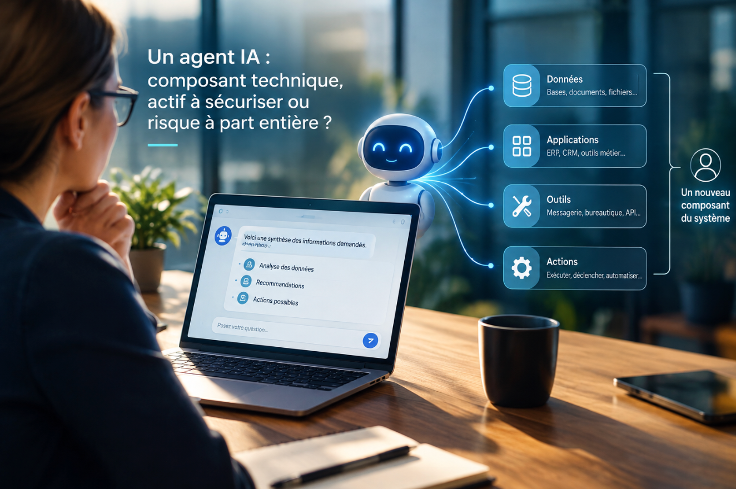
Artificial Intelligence is now entering a new phase in the business world.
Following conversational assistants and content-generation tools, we are now seeing the emergence of AI agents capable of interacting with applications, accessing data, using tools, and, in some cases, performing actions on behalf of a user or an organization.
It spread quickly!
These AI agents, often accessible through Open-source solutions or SaaS tools already integrated into our work environments, are gradually making their way into companies, sometimes faster than the governance processes needed to regulate their use.
A SAP LeanIX study published in 2026 indicates that of the companies surveyed are already deploying AI agents, while 40% are in the testing phase and 14% plan to adopt them.
https://www.leanix.net/en/download/agentic-ai-survey-2026
In other words, 98% of the organizations surveyed are already engaged, to varying degrees, in adopting, testing, or planning for AI agents.
We no longer work quite the same way. We have instant access to results, summaries, and proposals. The time spent searching for information or producing an initial deliverable has been significantly reduced, an acceleration that leaves almost no time for doubt, debate, consultation, or validation. Sometimes we get an answer before we’ve even really taken the time to formulate all the questions
All of this, in my view, is disruptive, especially in the field of risk management! The agent is no longer merely a tool at the user’s disposal but is gradually becoming a component that acts within the system on the user’s behalf.
This acceleration is obviously a tremendous opportunity. But it must also lead us to ask a fundamental question: what role does this “new player” actually play in an existing information system,whether it is mature, secure, or still not fully under control?
So this isn’t a question of whether this technological advancement is useful or not; it’s a question of how to integrate it into a system that’s already up and running. How do we actually integrate these new “digital colleagues” into our systems, processes, and value chains?
Today, there is a lot of talk about “AI risk,” data breaches, the risk of false positives, poor decision making, manipulation, the risk of compromise, and, finally, regulatory risk. All of these risks exist; they are, in fact, consequences associated with the use of these agents.
But if we try to take a step back and view this tool as an integral part of the company’s value chain,or even as an asset to be protected, our way of thinking may change.
This technological component has certain capabilities: It can access data, interact with applications, call services, use tools, generate information, or trigger certain actions.
It is, therefore, the combination of all these capabilities with its environment, its access points, its dependencies, the threats to which it is exposed, and the potential consequences of its use that contributes to the overall risk..
An isolated AI agent is therefore not, in and of itself, a risk. The risk arises from the relationship between its capabilities, its environment, its uses, and the potential consequences of its actions.
This distinction seems important to me when seeking to anticipate and manage the risks associated with the use of AI agents in the workplace.
So, how should we approach risk analysis from this perspective?
Ultimately, the question becomes quite simple: What approach should we take to analyze the risks associated with integrating an AI agent into a project or information system?
As with any new project aimed at improving or deploying an information system, , a risk analysis must be conducted during the project’s design phase,not after its deployment. From an integration perspective, the AI agent can therefore be considered a component of the system . It is therefore important to analyze its integration into the overall system as well as the risk scenarios that could arise from it.
It is not necessarily a matter of analyzing “the AI agent as a risk.” Rather, it is a matter of analyzing the risks associated with integrating this new “AI agent” component, examining its capabilities, its access privileges, its interactions, and its role within the system.
Perhaps that is where the real change lies. The issue, therefore, is not necessarily to create a new category called “AI risk.”
Perhaps the real change lies in having to adapt the way we describe and characterize the components of an information system:
- A server has capabilities
- An application has functions
- A user has rights
- Industrial equipment has the ability to take action
- And now, an AI agent also has the ability to interact and take action
However, these capabilities are highly dependent on the context in which the agent is used, the data it accesses, the instructions it is given, the tools it is authorized to use, and the systems with which it interacts.
It is precisely these elements that must be taken into account in a risk analysis.
In fact, this discussion goes well beyond the scope of cybersecurity alone.
If an AI agent is involved in a critical business process, the risks do not apply just to the CISO. They also affect the business unit that the agent supports, IT operations teams, and those responsible for risk management, compliance, data protection, intellectual property, business continuity, and depending on how the agent is used, personal safety as well.
It is precisely for this reason that I believe AI risk should not be treated as an isolated issue, but rather integrated into the overall risk management process. Like any other component of the information system, inadequate governance of AI can also have adverse effects.
